

Economic volatility has become a defining feature of today’s investment environment. Interest rate shifts, inflation cycles, labor market adjustments, and capital market repricing continue to influence investor decision-making. In periods of heightened uncertainty, investors increasingly prioritize assets that demonstrate stability, income durability, and long-term fundamentals.
Multifamily real estate investing has historically performed with resilience during economic volatility. While no asset class is immune to market disruption, multifamily performance has consistently benefited from needs-based demand, recurring income, and operational flexibility. These characteristics have allowed multifamily assets to navigate market volatility more effectively across real estate market cycles.
Over the past several years, the multifamily sector has moved through one of the most dynamic transitions in modern history. Understanding how those shifts unfolded provides important context for evaluating multifamily performance during volatile economic conditions.
A Look Back: How Multifamily Has Navigated Recent Volatility
To understand the volatility of the past five years, it is important to begin with the market conditions leading into 2020.
During the 2010s, multifamily housing fundamentals improved as construction lagged behind household formation after the global financial crisis. U.S. Census Bureau New Residential Construction data shows that for much of the decade, annual housing completions remained below long-term demand, contributing to elevated occupancy and limited available inventory. At the same time, interest rates remained historically low. The Federal Reserve held the federal funds rate below 2.5% for the entire decade, supporting transaction liquidity and cap rate compression across income-producing real estate.
By the end of 2019, multifamily entered the next cycle with strong occupancy, disciplined lending standards, and durable demand fundamentals already in place. Between 2020 and early 2022, known as the pandemic-era, monetary policy pushed borrowing costs to record lows, while fiscal stimulus and shifting living preferences accelerated household formation and rental demand. According to Yardi Matrix, national multifamily rent growth reached approximately 13.5% year-over-year in 2021, the strongest annual increase in the firm’s data history.
Rent growth remained elevated into 2022, finishing the year at roughly 6.2% nationally, still well above historical averages despite early signs of economic tightening. Operating performance strengthened broadly during this period as occupancy remained high and renter demand proved resilient, even as asset pricing accelerated faster than long-term income growth. By mid-2022 and into 2023, market conditions shifted significantly. The Federal Reserve launched the most aggressive rate-tightening cycle in decades, raising the federal funds rate from near zero in early 2022 to above 5% by mid-2023, increasing borrowing costs and expanding cap rates.
At the same time, multifamily construction pipelines that were initiated during the low-rate environment continued to deliver. Completions surged as projects that broke ground in prior years reached completion. In 2024, multifamily unit completions reached approximately 608,000 units nationally, the highest annual total since the mid-1980s. This elevated level of new supply created temporary pressure on vacancy and rent growth in select markets, even as long-term demand drivers remained intact.
By late 2024 and through 2025, conditions began to stagnate. Multifamily deliveries peaked while new construction starts declined sharply as higher financing costs constrained development activity. According to Yardi Matrix, national rent growth moderated significantly by late 2025, registering low single-digit annual increases. In mid-2025, year-over-year rent growth averaged approximately 0.7% nationally, reflecting stabilization rather than contraction. Vacancy rates also trended closer to historical norms. Marcus & Millichap reported that national multifamily vacancy declined from its 2024 peak, with further tightening expected as construction activity decelerates and demand continues to absorb delivered units.
Taken together, this progression underscores a defining characteristic of multifamily real estate. Even during periods of pronounced economic volatility, fundamentals adjusted rather than deteriorated. Supply responded to capital conditions, demand remained anchored by housing necessity, and performance rebalanced over time, reinforcing multifamily’s resilience across market cycles.
Why Multifamily Real Estate Performs Differently During Market Volatility
Needs-Based Demand Supports Stability
Housing is a non-discretionary expense, meaning it is a basic human need. During periods of market volatility, households may reduce discretionary spending, delay home purchases, or relocate, but the need for rental housing remains constant. In many economic slowdowns, affordability constraints push households toward renting rather than owning, reinforcing demand for multifamily apartment housing.
This structural demand has consistently supported occupancy levels and limited downside volatility relative to other commercial real estate sectors
Short Lease Terms Enable Faster Market Adjustment
Multifamily real estate benefits from relatively short lease durations, typically twelve months. This structure allows owners and operators to adjust rents more frequently than assets with long-term leases.
During inflationary periods, this supports income preservation. During slower periods, it allows operators to respond quickly through renewals, concessions, and pricing strategy adjustments. This flexibility plays a central role in stabilizing multifamily performance across real estate market cycles.
Income-Driven Returns Reduce Exposure to Volatility
Multifamily real estate investing is fundamentally income-driven. Net operating income, rather than speculative appreciation, is the primary driver of value over time.
Historical research from CBRE shows that income-producing multifamily assets typically exhibit lower return volatility than many other commercial real estate sectors. Although valuations respond to capital market shifts, consistent rental income supports performance and provides stability in economic volatility.
Supply Is Easing While Demand Remains Structurally Sound
After several years of elevated development, new multifamily construction has slowed materially. According to RealPage, construction starts declined meaningfully through 2024 and 2025 as financing costs increased and underwriting became more disciplined.
At the same time, renter demand has remained resilient. Household formation, demographic trends, and affordability pressures continue to support absorption even as broader economic growth moderates. National occupancy levels have remained near long-term averages, reinforcing operational stability.
Marcus & Millichap projects that units under construction will continue declining into 2026, creating a more balanced supply-demand dynamic. As the year move forward, this environment supports steadier multifamily performance.
Rent Growth Is Stabilizing Through Market Volatility
Although rent growth slowed from the extraordinary pace recorded earlier in the cycle, pricing conditions have stabilized. According to analysis from Arbor Realty Trust and Moody’s Analytics CRE, national rent growth has normalized to low single-digit levels while remaining well above pre-pandemic pricing benchmarks.
Importantly, the current rent environment reflects normalization rather than weakness. Markets are transitioning from a period of rapid expansion to one characterized by sustainable growth. As new supply diminishes and wage growth continues in many employment centers, rent growth is increasingly driven by fundamentals rather than momentum.
This shift matters for multifamily investors. Stabilized rent growth supports underwriting confidence, reduces forecast risk, and improves the predictability of cash flow during periods of economic volatility. Historically, these environments have rewarded disciplined investors who prioritize durable income and risk-adjusted returns over short-term growth.
Why Investors Favor Multifamily Real Estate Investing in Volatile Markets
Multifamily real estate continues to attract capital during periods of economic volatility because it offers several structural advantages.
Diversified Tenant Bases Reduce Concentration Risk
Multifamily properties generate income from hundreds or thousands of households rather than a small number of tenants. This diversification mitigates concentration risk by spreading income exposure across multiple employment sectors, income levels, and household profiles. Job losses or income disruptions in any single industry are less likely to materially impair property-level cash flow, which contrasts sharply with asset classes reliant on a limited number of large tenants or long-term corporate leases.
Predictable and Recurring Income Improves Cash Flow Visibility
Housing demand is driven by necessity rather than discretionary spending, resulting in consistent rent payments across economic environments. Monthly lease structures create recurring income streams, providing operators with strong visibility into near-term cash flow. This predictability supports disciplined expense management, proactive capital planning, and more reliable distributions to investors.
Lease Resets Provide Inflation-Responsive Revenue
Multifamily leases typically reset annually, allowing rental rates to adjust over time in response to inflation and market conditions. This dynamic pricing mechanism helps preserve purchasing power by aligning revenue with rising operating costs and replacement values. Compared to long-duration leases with fixed escalations, multifamily offers greater flexibility to recalibrate income as economic conditions evolve.
Lower Correlation to Public Markets Reduces Portfolio Volatility
Private multifamily investments typically show lower correlation with public equities and fixed-income markets. Property values are primarily influenced by local supply and demand fundamentals, operational performance, and demographic trends rather than daily market sentiment. This characteristic can help dampen portfolio volatility during periods of public market stress.
Durable Demand Across Market Cycles
Housing remains a fundamental human need regardless of economic conditions. Even during downturns, demand for rental housing persists as affordability constraints limit homeownership, and household formation continues. This structural demand supports occupancy stability and underpins long-term performance across real estate cycles.
For investors focused on risk-adjusted returns rather than speculative appreciation, these attributes reinforce multifamily’s role as a core allocation during uncertain environments.
How Multifamily Investors Can Position Through Economic Volatility
Investors evaluating multifamily opportunities during volatile markets should focus on disciplined fundamentals and conservative underwriting. Here are four important factors to evaluate when considering a multifamily investment opportunity:
A) Evaluate the Investment Firm
Assess experience across multiple real estate market cycles, reporting transparency, and approach to downside risk management.
B) Assess Market Fundamentals
Review job growth, supply pipelines, renter demographics, and long-term demand drivers to confirm durability.
C) Review Capital Structures
Understand leverage levels, debt terms, and how equity positioning impacts downside protection.
D) Validate Tax Strategy Support
Confirm access to depreciation strategies, cost segregation analysis, and guidance on optimizing after-tax outcomes.
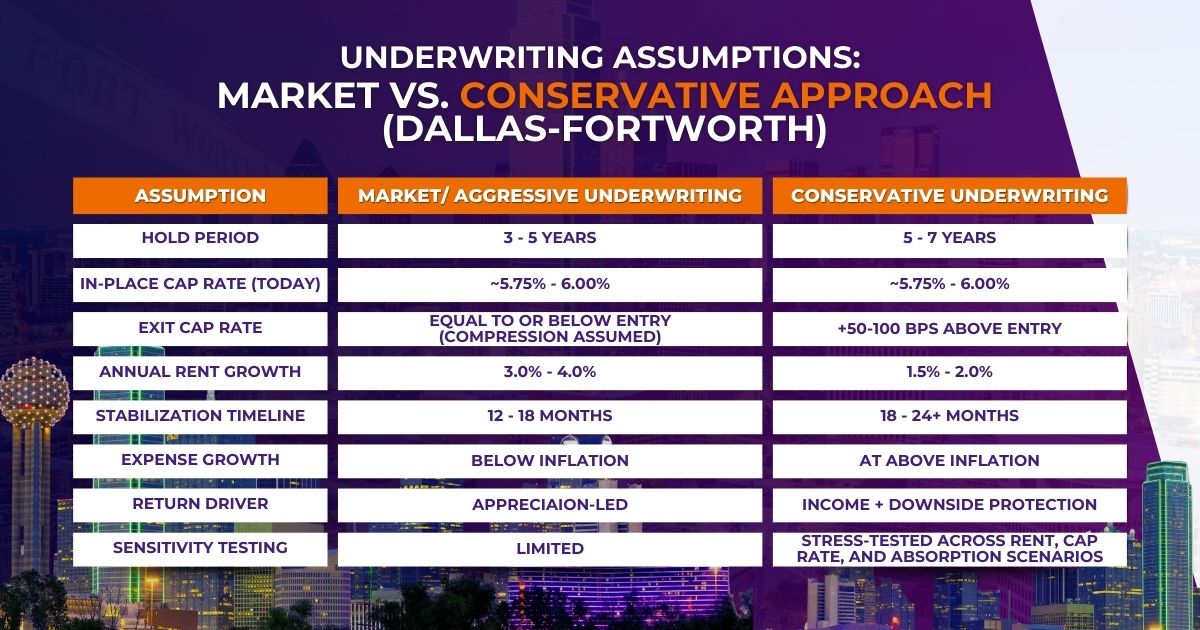
Marcus & Millichap recommends stress-testing underwriting assumptions for slower rent growth and extended stabilization timelines to ensure resilience during economic volatility.
Below is a chart that compares Market vs. Conservative Approach in the Dallas Area Today:
What Economic Volatility May Mean Going Forward
Forecasts from CBRE, Freddie Mac, and RealPage suggest that as construction pipelines contract and interest rate policy stabilizes, multifamily fundamentals may continue strengthening through 2026 and beyond. Markets with balanced supply and durable demand could experience renewed pricing power, while improved capital market clarity may support valuation stability.
Investors who deployed capital during periods of caution rather than optimism have often been better positioned for the next phase of the cycle. Following the global financial crisis, capital allocated to multifamily between 2010 and 2012 benefited from discounted pricing, limited new supply, and a multi-year recovery in rents and values. Similarly, investors who entered the market during the early-1990s recession and the post-dot-com slowdown captured outsized returns as employment growth resumed and housing demand reaccelerated. In each case, disciplined entry during periods of uncertainty aligned capital with improving fundamentals rather than peak sentiment.
Why Multifamily Remains a Resilient Long-Term Strategy
Multifamily real estate remains a resilient long-term investment strategy because it delivers durable income, operational adaptability, and demand driven by fundamental housing needs. Even during periods of economic volatility, well-located and well-managed multifamily assets continue to generate recurring cash flow, supported by diversified tenant bases and shorter lease terms that enable owners to adjust rents and expenses in real-time. While market cycles and capital markets introduce periodic pricing volatility, the core operating performance of multifamily has remained steady. This combination of predictable income, structural demand, and active management flexibility has consistently positioned multifamily to weather downturns and participate meaningfully in recoveries across market cycles.
For investors focused on capital preservation, steady income, and long-term wealth creation, multifamily real estate remains one of the most durable investment strategies available.
How Viking Capital Navigates Economic Volatility
Periods of economic volatility require experience, discipline, and a fundamentals-first approach. Viking Capital has spent more than a decade navigating multiple market cycles focused on risk management, income durability, and long-term performance.
Our investment approach is built around flexibility. Economic conditions, investor objectives, and risk tolerance are not uniform, and neither are our deal structures. Viking Capital offers a range of investment structures designed to align with different priorities, including long-term equity growth, income-focused strategies, and capital stack configurations that emphasize downside protection during periods of market volatility.
This ability to structure investments thoughtfully becomes increasingly important when markets are transitioning. During volatile or late-cycle environments, structure can play a critical role in managing risk, improving income predictability, and supporting consistent multifamily performance across real estate market cycles.
As conditions stabilize, opportunities often emerge where creative capital structuring enhances risk-adjusted returns. This can include recapitalizations or repositioned capital stacks that better reflect today’s financing environment and demand fundamentals. Viking Capital has applied this disciplined approach across its portfolio, including assets such as Avondale Commons, where market fundamentals and structure are aligned to support income stability while preserving long-term upside potential.
Avondale Commons
For investors positioning capital in the 2026 cycle, experience and structure matter. Viking Capital’s track record across multiple market environments reflects a disciplined approach to identifying opportunities, structuring investments thoughtfully, and executing with precision.
As markets stabilize, opportunities like Avondale Commons highlight how strong fundamentals and intentional capital structuring can support income durability and long-term upside.
To learn more about how Viking Capital is positioning this investment, you can explore the Avondale Commons opportunity or connect with our team for a strategy-focused discussion.
Opportunities to Learn More
👉 Explore Avondale Commons
👉 Book a free 15-minute strategy call
👉 Read more on recapitalizations